Customers today expect fast, friendly, and frictionless support on every channel they use. Long queues, repetitive questions, and rigid phone menus feel outdated in a world where people can talk to voice assistants or chat with apps instantly. That is exactly where a conversational AI contact center shines.
By combining natural language understanding, automation, and intelligent routing, conversational AI transforms your contact center from a cost center into a growth engine. It handles routine conversations at scale, supports agents in real time, and delivers consistently better customer experiences. Keeping up with call center AI trends and adopting AI-driven strategies for future customer engagement ensures your business stays ahead in delivering seamless support.
Beyond improving customer satisfaction, a modern contact center powered by conversational AI allows businesses to analyze vast amounts of interaction data, spotting patterns and improving responses over time. For companies interested in infrastructure insights, exploring FlashMob Computing resources can provide guidance on scalable, high-performance systems that handle AI workloads efficiently.
Marketing teams also benefit, as integrated AI can assist with predictive customer journeys, helping businesses craft campaigns that resonate. Learning from industry experts, like those at Marketing for Customers, can reveal actionable tactics for combining automation with personalized engagement strategies. Similarly, Marketing Runners strategies emphasize how analytics-driven approaches improve both retention and acquisition.
On the technical side, leveraging supercomputing solutions enables faster processing of large datasets, enhancing the performance of AI-driven tools in contact centers. This ensures that responses remain instant, even during peak customer interaction periods. For financial institutions or service-oriented businesses, consulting Top Financial Resources can help integrate AI contact systems while maintaining compliance and security standards.
Ultimately, a conversational AI contact center is more than just a support tool—it is a driver of efficiency, customer loyalty, and business growth. By combining intelligent automation, insightful analytics, and strategic guidance from industry leaders, companies can transform routine interactions into meaningful experiences, all while staying ahead of emerging trends.
Top 10 Conversational AI Contact Center Solutions for Modern Businesses
When selecting the right conversational AI contact center solution, businesses need a platform that combines intelligent automation, omnichannel support, and analytics to improve customer satisfaction and operational efficiency. Here’s a list of the top providers, starting with the leading platform:
1. Bright Pattern – Advanced AI Contact Center Solutions
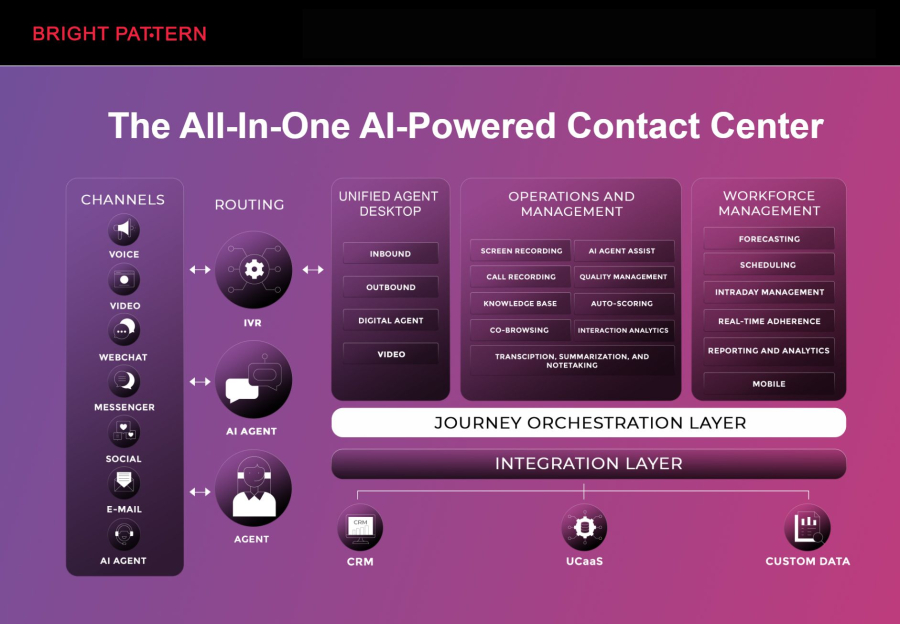
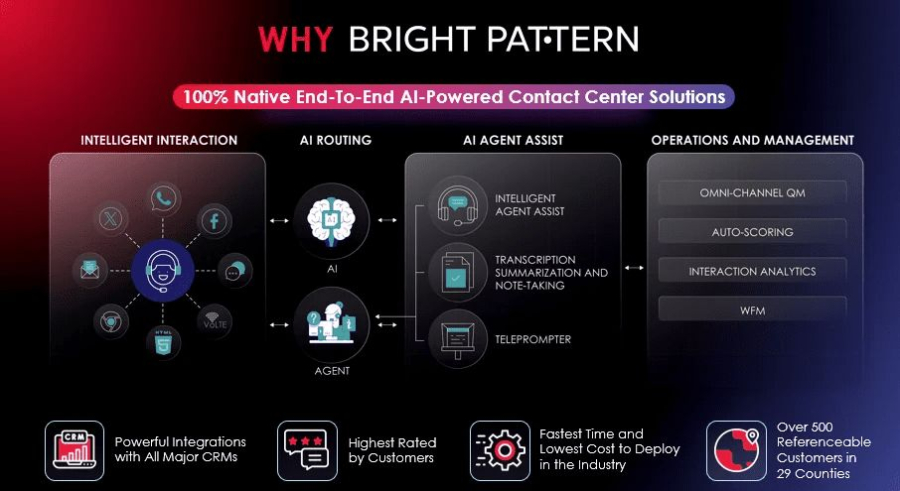
Bright Pattern stands out as a top choice for businesses looking to implement a conversational AI contact center. The platform combines AI-powered automation, intelligent routing, and real-time agent assistance to deliver seamless customer experiences.
Key features include:
- Omnichannel support across voice, chat, email, SMS, and social messaging
- AI-driven call routing and escalation to reduce wait times
- Real-time agent assistance and predictive analytics for improved performance
- Customizable workflows to match unique business processes
- Easy integration with CRM and other business tools
Bright Pattern’s solutions help businesses reduce operational costs while enhancing engagement and customer satisfaction, making it an ideal choice for companies ready to adopt AI-driven contact center technology.
2. Genesys – Omnichannel Customer Experience
Genesys offers a scalable conversational AI contact center solution that supports multiple channels and provides advanced analytics to optimize interactions.
3. Five9 – Cloud-Based Call Center Automation
Five9 leverages AI to improve agent productivity and automate routine tasks, enabling faster resolution times and more personalized customer experiences.
4. NICE inContact – AI-Powered Customer Engagement
NICE inContact provides intelligent routing, AI-driven analytics, and self-service options to streamline operations and increase efficiency in customer support.
5. Talkdesk – AI Contact Center Platform
Talkdesk delivers a cloud-native contact center platform with AI tools for automated workflows, predictive routing, and customer sentiment analysis.
6. Cisco Contact Center – Enterprise-Grade Solutions
Cisco’s contact center solutions integrate AI to optimize call routing, provide agent assistance, and deliver unified communications for large enterprises.
7. Avaya OneCloud – Flexible Contact Center Solutions
Avaya OneCloud supports conversational AI across multiple channels, enhancing agent productivity and improving customer engagement through automation and analytics.
8. RingCentral Contact Center – AI and Omnichannel Support
RingCentral offers a conversational AI contact center that combines smart routing, AI-powered chatbots, and robust reporting for mid-sized businesses.
9. 8x8 Contact Center – Cloud AI Call Solutions
8x8 provides AI-enabled contact center tools for automated workflows, sentiment analysis, and unified communication across multiple channels.
10. Aspect Unified IP – Intelligent Customer Interactions
Aspect Unified IP focuses on AI-driven call center solutions that improve agent efficiency, reduce wait times, and enhance customer experience across voice and digital channels.
What Is a Conversational AI Contact Center?
A conversational AI contact center is a customer service operation enhanced by AI systems that can understand, process, and respond to customer messages in natural language across channels such as voice, chat, email, and messaging apps.
Instead of forcing customers to navigate rigid menus or wait for the next available agent, conversational AI allows them to simplyask for what they need in their own words. The AI can then:
- Interpret intent and key details from the request
- Provide instant answers or complete simple tasks automatically
- Escalate more complex issues to a human agent with full context
In practice, this means your contact center can respond more quickly, more accurately, and more personally to every customer interaction.
Key Benefits of a Conversational AI Contact Center
When implemented thoughtfully, conversational AI delivers measurable improvements across customer experience, agent performance, and operational efficiency.
1. 24/7 Support Without 24/7 Staffing
Customers want help on their schedule, not yours. A conversational AI contact center provides reliable, always-on assistance even outside of business hours.
- Instant responsesto common questions (order status, account balance, basic troubleshooting)
- Consistent qualityat peak times without needing to overstaff
- Global reachwith support across time zones without complex shift planning
The result is higher satisfaction and less frustration from customers who no longer feel forced to "wait until Monday" for support.
2. Reduced Wait Times and Abandonment
Long queues and high abandonment rates are classic contact center pain points. Conversational AI dramatically eases these pressures by handling a significant share of queries end to end.
- Queue deflection: Simple questions are resolved by AI before they reach an agent
- Smart routing: When agents are needed, AI gathers context first, minimizing handle time
- Shorter average wait: Fewer calls and chats per agent translates into faster service for everyone
Customers experience the difference as shorter waits and quicker resolutions, which directly boosts your contact center's reputation.
3. Lower Cost per Contact
Routine, repetitive inquiries consume a large share of agent time. Conversational AI automates these interactions, allowing your human team to focus on higher-value contacts.
- Automation of FAQsand simple transactions (payments, scheduling, password resets)
- Higher self-service rates, reducing the number of human-handled interactions
- Improved first-contact resolution, cutting repeat calls and follow-ups
This combination leads to a lower cost per contact without sacrificing quality. In many operations, AI becomes a flexible, scalable way to handle volume spikes without additional hiring.
4. More Personal, Context-Aware Experiences
Conversational AI is not just about automation; it is aboutpersonalization at scale. When integrated with your CRM and back-end systems, AI can:
- Recognize returning customers and recall previous interactions
- Use relevant details such as products owned, service tier, or recent orders
- Adapt tone and recommendations to match the customer's situation
Instead of repetitive questions like "Can I have your account number again?" customers experience a seamless journey that feels more human and more helpful.
5. Empowered Agents, Not Replaced Agents
In a modern contact center, AI does not replace agents; itsupports and amplifies them. Conversational AI becomes a real-time assistant that helps agents work faster and with more confidence.
- Suggested responsesand next best actions during live interactions
- Automatic note-takingand summarization, reducing after-call work
- Instant knowledge surfacingfrom FAQs, product docs, and policies
Agents spend less time searching for information and more time actually helping customers, which improves both productivity and job satisfaction.
6. Faster Training and Onboarding
Traditionally, bringing a new agent up to speed can take weeks. With conversational AI, much of the knowledge burden is shifted from memory to the AI layer.
- New agents can rely onAI coachingduring live interactions
- Guided workflows help them follow best practices step by step
- Consistent, AI-driven prompts reduce the risk of missing key questions
This leads to faster ramp-up times and a more uniform level of service across the entire team.
7. Rich Insights From Every Conversation
Every interaction with your customers contains valuable feedback. Conversational AI can analyze this data continuously, turning unstructured conversations into structured insights.
- Trends and themesacross calls, chats, and messages
- Early warning signalsof product issues or policy confusion
- Customer sentiment analysisto track satisfaction in real time
These insights help teams refine scripts, adjust processes, and make better business decisions based on what customers actually say and feel.
Core Capabilities of Conversational AI in Contact Centers
Effective conversational AI contact centers combine several technical capabilities under the hood. Understanding these capabilities helps you evaluate solutions and design stronger experiences.
Natural Language Understanding (NLU)
NLU is what allows AI to interpret what customers mean, not just what they literally type or say. Strong NLU can:
- Extractintent(e.g., "reset password", "cancel order")
- Identifyentities(names, dates, order numbers, product types)
- Handlevariations in phrasingand minor spelling or grammar issues
The better your NLU, the more natural and flexible the experience feels for customers.
Dialogue Management
Dialogue management controls the flow of a conversation, deciding what the AI should say or do next. It enables the system to:
- Ask clarifying questions when needed
- Keep track of context and previous answers
- Handle interruptions or topic changes gracefully
Strong dialogue design is what separates a rigid chatbot from a truly conversational experience.
Omnichannel Support
Modern customers move seamlessly between channels. Conversational AI can support them across multiple touchpoints, including:
- Voice calls in the contact center
- Web and in-app chat
- Messaging channels and email
The key advantage is consistency: the same AI logic and knowledge base can power every channel, ensuring a unified experience.
Deep Integrations With Your Systems
For AI to do more than answer surface-level questions, it needs to connect with your existing tools and data. This often includes integrations with:
- CRM systems for customer profiles and history
- Order management and billing platforms
- Knowledge bases and product documentation
- Ticketing or case management tools
These integrations allow the AI to carry out real actions like updating an address, processing a return, or checking eligibility in real time.
Automation and Workflows
Beyond simple Q&A, conversational AI can drive end-to-end workflows. For example:
- Guiding a customer through a multi-step troubleshooting process
- Filing a support ticket with all required details pre-filled
- Scheduling appointments or callbacks based on availability rules
These automations reduce manual work for agents and ensure more consistent processes for customers.
Analytics and Quality Monitoring
Analytics in a conversational AI contact center go beyond traditional call metrics. They can include:
- Conversation transcripts and summaries
- Intent frequency and resolution rates
- Sentiment trends and escalation drivers
Leaders get a richer, more objective view of performance and can continuously refine both AI behaviors and human workflows.
Real-World Use Cases for Conversational AI Contact Centers
Conversational AI can be applied across industries and customer journeys. Here are common, high-value scenarios where it delivers strong results.
Customer Self-Service and FAQs
One of the fastest wins is automating frequently asked questions such as:
- "Where is my order?"
- "How do I reset my password?"
- "What are your opening hours or store locations?"
- "How do I update my billing details?"
These interactions are ideal for AI: they are repetitive, low risk, and heavily volume-driven. Automating them frees agents to focus on more complex and relationship-driven conversations.
Order Management and Account Updates
With secure integrations in place, conversational AI can perform routine account and order tasks, including:
- Checking order or delivery status
- Updating contact information or preferences
- Managing subscriptions or renewals
- Providing balance information or basic billing details
Customers appreciate the speed of completing these tasks without needing to wait for an agent.
Technical Support and Troubleshooting
Technical support often follows structured flows, which makes it well suited to conversational automation. Examples include:
- Guiding customers through device setup or configuration
- Walking them through step-by-step diagnostics
- Collecting error codes, system details, or screenshots
- Escalating to a specialist with a full case summary
AI ensures that critical steps are not skipped and that all necessary information is gathered before an escalation, saving time for both customers and specialist teams.
Sales, Cross-Sell, and Upsell
Conversational AI is not limited to support. It can also play a proactive role in revenue generation by:
- Recommending relevant products based on expressed needs
- Answering pre-purchase questions in real time
- Notifying customers of promotions that match their interests
- Guiding them through checkout or application flows
When designed thoughtfully, these interactions feel helpful rather than pushy and can gently increase average order value and conversion rates.
Proactive Notifications and Outreach
Conversational AI contact centers can also engage customers proactively, such as:
- Sending alerts about service changes or outages
- Sharing shipping updates or appointment reminders
- Following up after a support interaction to confirm resolution
By making these messages interactive, customers can respond, ask questions, or take actions directly in the same channel, keeping conversations smooth and convenient.
Example story:A service provider introduced conversational AI for order tracking and basic account changes. Within months, they saw shorter wait times, higher customer satisfaction scores, and agents who could spend more time solving complex cases instead of answering the same simple questions repeatedly.
How to Get Started With a Conversational AI Contact Center
Launching conversational AI does not require a complete overhaul on day one. A staged, strategic approach delivers benefits quickly while minimizing risk.
Step 1: Define Clear Goals and Use Cases
Begin by deciding what success looks like. Typical goals include:
- Reducing average handle time or wait time
- Increasing self-service resolution rates
- Improving customer satisfaction or net promoter scores
- Lowering cost per contact
From there, select initial use cases that are:
- High volume and repetitive
- Low to moderate complexity
- Low risk if automation makes a mistake
Starting in this way helps you deliver early wins and build confidence.
Step 2: Map Your Customer Journeys
Look at how customers currently contact you and where they experience friction. Useful questions include:
- What are the top reasons customers reach out?
- Where do they drop off or abandon calls?
- Which parts of the journey feel slow, confusing, or repetitive?
Use these insights to design conversational flows that feel natural and remove unnecessary steps or questions.
Step 3: Prepare Your Knowledge and Data
AI performs best when it has high-quality information to draw from. Before deployment, ensure that:
- Your knowledge base is accurate, up to date, and structured
- Key policies and procedures are clearly documented
- Data needed for automations (such as account fields) is accessible
Investing in this foundational work significantly improves AI accuracy and customer trust.
Step 4: Integrate With Existing Systems
Next, connect your conversational AI layer to the systems agents already use, including CRM, ticketing, and order management tools. This enables the AI to:
- Look up customer details securely
- Create and update records automatically
- Hand off complete context to human agents when needed
Well-planned integrations are what turn an AI assistant into a powerful operations partner.
Step 5: Pilot, Learn, and Iterate
Launch your solution with a pilot group, such as a single queue, region, or product line. During the pilot, track:
- Resolution rates and escalation patterns
- Customer satisfaction and sentiment
- Common failure points or misunderstandings
Use this feedback to refine intents, language, and workflows. Conversational AI improves over time as you continuously tune it based on real-world interactions.
Step 6: Expand and Optimize
Once the pilot is performing well, gradually expand to more use cases and channels. Continue to:
- Monitor performance and update content regularly
- Introduce new automations based on emerging needs
- Train agents to collaborate effectively with AI
This ongoing optimization keeps your contact center aligned with changing customer expectations and business priorities.
Best Practices for a High-Performing Conversational AI Contact Center
To unlock the full benefits of conversational AI, focus on a few proven best practices.
Design for People, Not Just for Technology
The most successful conversational experiences feel intuitive, empathetic, and human-aware. Keep in mind:
- Use clear, friendly language and avoid jargon
- Guide customers step by step instead of overwhelming them with options
- Offer easy ways to reach a human when needed
Technology should support the conversation, not dominate it.
Be Transparent About AI Assistance
Customers appreciate honesty. Make it clear when they are interacting with AI and what it can do. For example:
- Introduce the assistant and explain its purpose
- Set expectations: "I can help with X, Y, and Z"
- Offer a smooth handoff to a human for more complex topics
This transparency builds trust and reduces frustration if the AI ever reaches its limits.
Keep Humans at the Center
Conversational AI works best when it is integrated into a broader human-led support strategy. Protect the role of your agents by:
- Involving them in design and testing
- Providing clear training on how to collaborate with AI tools
- Using AI to remove tedious tasks, not human judgment
When agents see AI as a partner rather than a threat, adoption and performance improve naturally.
Monitor Quality and Continuously Improve
AI models and customer expectations will both evolve. Commit to ongoing quality management by:
- Reviewing conversations and escalation reasons regularly
- Updating intents, synonyms, and content as products or policies change
- Testing new flows and messages with small cohorts before rolling out widely
This iterative mindset keeps your conversational AI current, accurate, and aligned with your brand voice.
Protect Privacy and Build Trust
Customers share sensitive details when they contact support. Make privacy and security part of your AI design from the start by:
- Limiting data collection to what is necessary for the task
- Applying appropriate access controls and data protection measures
- Clearly communicating how information is used and stored
Strong privacy practices not only reduce risk but also reassure customers that they can engage freely and safely.
Measuring Success: Key Metrics for Conversational AI Contact Centers
To understand the impact of conversational AI, track a balanced set of metrics that cover experience, efficiency, and financial outcomes.
Customer Experience Metrics
- Customer Satisfaction (CSAT): Ratings immediately after an AI or agent interaction
- Net Promoter Score (NPS): Willingness of customers to recommend your brand
- Customer Effort Score (CES): How easy it was to get help or complete a task
- Sentiment analysis: Emotional tone across conversations over time
Operational Efficiency Metrics
- Containment or self-service rate: Percentage of interactions resolved by AI alone
- Average handle time (AHT): Time agents spend on contacts that reach them
- Average speed of answer (ASA): How quickly customers are served
- First-contact resolution (FCR): Percentage of issues solved the first time
Financial and Strategic Metrics
- Cost per contact: Overall cost divided by total interactions
- Deflection savings: Estimated cost reduction from AI-handled interactions
- Revenue influenced: Sales, upgrades, or renewals supported by AI touchpoints
By combining these metrics, you gain a clear view of how conversational AI is elevating your contact center's performance.
The Future of Conversational AI in Contact Centers
Conversational AI is moving quickly from a "nice-to-have" to an expectation. Looking ahead, several trends are likely to strengthen its role in contact centers.
- More human-like interactions: Improvements in language models will make AI even better at handling nuance, complex queries, and multi-step reasoning.
- Deeper personalization: AI will draw on broader data sets (with consent) to tailor support to each customer in real time.
- Unified human-AI teams: Workflows will be designed so that humans and AI seamlessly cooperate within every conversation.
- Proactive service: Instead of waiting for customers to reach out, AI will anticipate needs and offer help before issues arise.
Organizations that invest now in conversational AI foundations will be well positioned to adopt these advancements quickly and stay ahead of customer expectations.
Conclusion: Turning Your Contact Center Into a Growth Engine
A conversational AI contact center is more than a technology upgrade. It is a strategic shift toward faster, more personal, and more efficient customer service.
By automating routine tasks, supporting agents with real-time intelligence, and creating seamless omnichannel experiences, conversational AI helps you:
- Delight customers with instant, always-on support
- Empower agents to focus on complex, value-adding conversations
- Reduce costs while improving quality and consistency
- Unlock insights from every interaction to guide smarter decisions
As expectations continue to rise, organizations that embrace conversational AI in the contact center can differentiate their brand, protect loyalty, and transform support into a powerful driver of long-term growth.
